
# When a Mother Cannot Work: Why a Family’s Income Does Not Necessarily Mean It Is Not Poor
When a Mother Cannot Work: Why a Family’s Income Does Not Necessarily Mean It Is Not Poor
Nargiza’s family has four minor children. Her husband works and earns UZS 2.8 million per month. The family also receives government benefits: UZS 920,000 as a disability pension for their daughter and another UZS 640,000 as a caregiving allowance.
Simply adding these figures gives us the family’s income. But the numbers do not show the full picture.
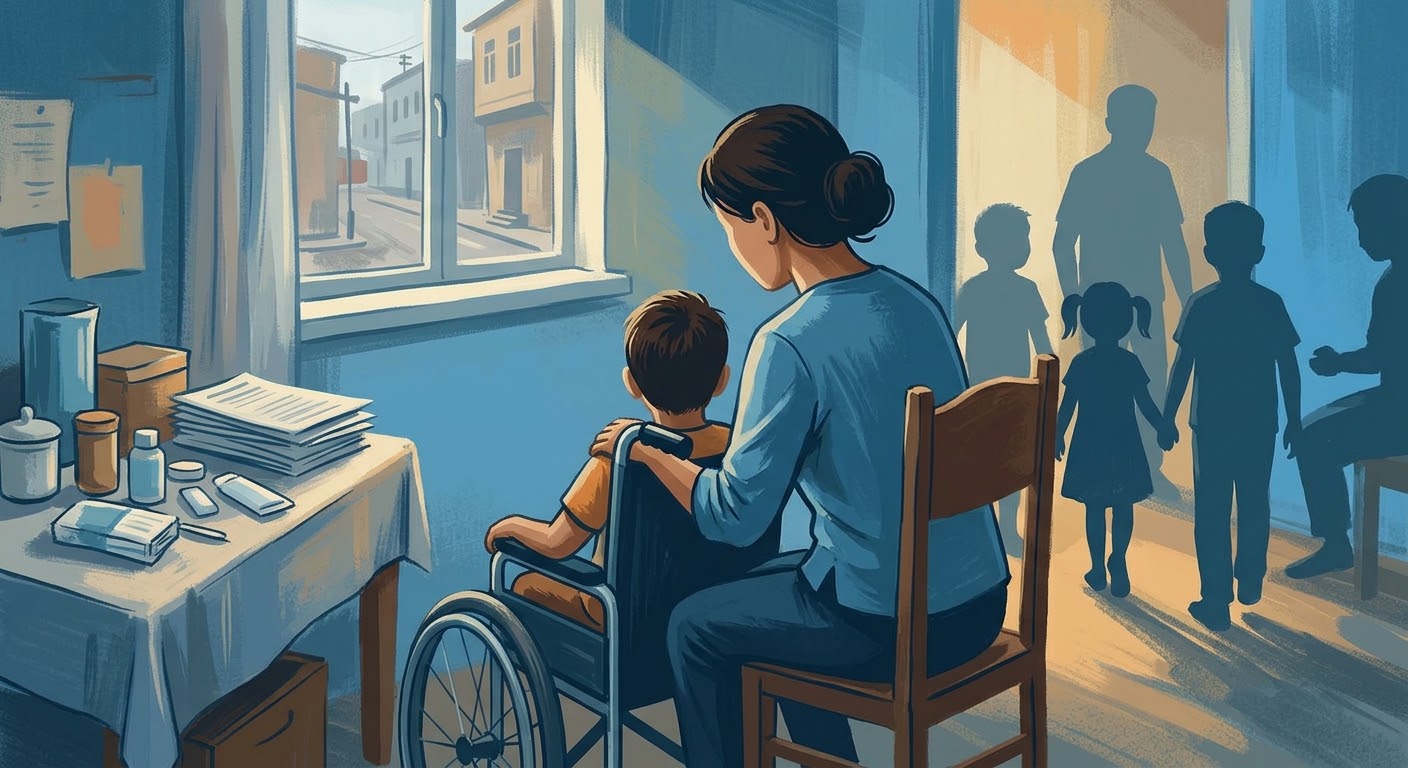
Nargiza’s daughter has had a disability since childhood. Her medical records list meningoencephalitis, epilepsy, microcephaly, and limb atrophy. The girl requires care, which is why her mother does not work.
Seen from this perspective, the family budget looks very different: one adult earns the money that supports the family, while the other performs unpaid work, caring for a sick child every day. A total of 13 people live in the household.
Nargiza’s story is one of the cases encountered by the ONA Public Foundation. It illustrates why the question “How much does a family earn?” does not always answer another, much more important question: how much does that family actually have left to live on?
Illness Creates Expenses and Reduces the Ability to Earn
On September 3, 2026, Uzbekistan announced a revision of the criteria used for the Social Registry. The assessment of need is expected to take into account not only income but also chronic illnesses, disability, the number of children in a family, family members working abroad, and other social circumstances. The same official announcement stated that while the national poverty rate stands at 3.9%, it reaches 6.5% among families with children under the age of three.
This is particularly important for families raising children with serious illnesses. The ONA Foundation’s records include cases in which documents directly link a mother’s inability to work to the need to care for a sick child or a child with a disability.
These cases are not representative statistics for Uzbekistan, nor do they indicate the proportion of such families among all applications received by ONA. They do not allow such conclusions to be drawn. They do, however, reveal a recurring situation faced by families.
Mehriniso has three minor children. The family rents their home. Her son has had a disability since childhood and has extrahepatic portal hypertension, esophageal varices, and severe hemorrhagic anemia. According to the Foundation’s records, since 2022 the child has periodically been admitted to intensive care because of bleeding. Mehriniso does not work. The documents state the reason explicitly: she stays at home to care for her child with a disability.
There is also the story of Lobar, a single mother. Her son has had a disability since childhood and has symptomatic epilepsy and beta-thalassemia. A bone marrow transplant costing USD 77,500 was considered, but it could not be performed due to a lack of funds. Lobar does not work either because she cares for her son.
Another mother, Rayhon, is temporarily unemployed and stays at home with her daughter. The girl has a disability, uses a wheelchair, studies at home, and requires ongoing care supplies.
Despite different diagnoses and family circumstances, the same economic pattern emerges: a child’s serious illness can affect the family budget twice. On the one hand, there are expenses for treatment, medication, rehabilitation, transportation, specialized care supplies, and other needs. On the other hand, the family may lose part of its potential income because the child cannot be left alone.
“Caring for a Seriously Ill Child Is Work. It Is Simply Unpaid”
“When a mother spends years caring for a child who requires constant support, we cannot simply describe her as ‘unemployed.’ She works every day, but she is not paid for that work. If we assess a family’s situation solely through its monetary income, we risk overlooking two burdens at once: how much the family is forced to spend because of the illness and how much it is unable to earn because someone must provide constant care,” says Armenui Ispiryan, Director of the ONA Public Foundation.
This issue extends far beyond the few cases documented by the Foundation. According to UNICEF, as of June 2026, there were approximately 122,300 children with disabilities in Uzbekistan.
UNICEF also reports that more than 60,000 people received allowances for caring for children with disabilities through the social protection system. The organization also highlights ongoing work to analyze the cost of accessing social services for families raising children with disabilities.
In its assessment of the gender situation in Uzbekistan, the World Bank identifies women’s caregiving responsibilities and domestic work as factors that limit their economic participation. In other words, unpaid care is not an exceptional circumstance affecting a single family. It is a factor that can directly influence a household’s economic situation.
The Same Income, Two Completely Different Families
“You can place the documents of two families side by side and see the same income. But in one family, two adults work, the children are healthy, and the family owns its home. In the other, one parent financially supports everyone, while the other provides round-the-clock care for a child with a disability. The family rents its home and buys medication every month. On paper, their income may be the same, but in reality, their financial circumstances are entirely different,” says Shirin Djanibekova, a member of the ONA Board of Trustees.
This is why, when reviewing applications, the Foundation’s Board of Trustees does not look at a single figure alone. It considers the composition of the family, the child’s illness or disability, the parents’ ability to work, housing conditions, the cost of treatment, and regular essential expenses. This is the reality that a multidimensional assessment of need should seek to capture.
Leaving the Registry Does Not Necessarily Mean Leaving Poverty Behind
For a family, poverty does not end on the day its income rises above a certain figure. It ends when the family can independently cover its essential expenses and when the next crisis does not push it back into hardship, whether that crisis is another hospitalization, the cost of medication, surgery, or the need to leave a job to care for a child.
In September, the National Agency for Social Protection separately emphasized that removing a family from the Social Registry does not in itself mean that poverty has been reduced. Such a decision should be based on an actual improvement in the family’s socioeconomic situation.
Behind a single line reading “family income” can be very different realities. Sometimes it means one parent’s salary, an allowance, four children, and a mother who receives no salary because her working day never ends.
Her work is simply called care.
Sources
● Official website of the President of the Republic of Uzbekistan, “The System of Work to Reduce Poverty and Increase Household Incomes Will Be Transformed,” September 3, 2026
● UNICEF Uzbekistan, “Inclusion Through the Eyes of Children,” June 2, 2026
● UNICEF Uzbekistan, “Social Protection”
● World Bank, Uzbekistan Country Gender Assessment
● Public statement on the position of the National Agency for Social Protection regarding the removal of families from the Social Registry
The names of the women featured in this article have been changed to protect their personal data. The families’ circumstances, medical information, and financial data are based on materials provided by ONA.